Instant Connection for Pixel Streaming
— New Feature Automated Setup

How to Use Autodesk Fusion With Claude: MCP & Computer Use
Engineering
-
How to Use Autodesk Fusion With Claude: MCP & Computer Use
Engineering
How to Use Autodesk Fusion With Claude: MCP & Computer Use
Engineering
-
Table of Contents
Claude can work with Autodesk Fusion in two different ways. In the simplest workflow, it can explain modeling steps or generate Fusion API code that you apply manually. A connected workflow goes further by linking Claude to a live Fusion session through an Autodesk Fusion MCP Server or by allowing it to interact with the visible desktop through Computer Use.
MCP gives Claude structured access to supported Fusion tools and data. Depending on the available server capabilities, Claude may inspect the active document, review components, execute modeling commands, or query cloud-based hubs, projects, folders, and design items. Computer Use handles the visual side of the workflow. It can interpret screenshots, open Fusion panels, click controls, type values, navigate dialogs, and verify the result on screen.
The two methods work best together. MCP provides more precise and repeatable operations, while Computer Use helps Claude navigate the interface and confirm what actually happened. This is not a native one-click Fusion feature. It requires a compatible Claude environment, an MCP connection or Computer Use runtime, a running Fusion desktop session for local modeling, and user approval before consequential changes.
What Can Claude Do With Fusion Through MCP and Computer Use?
Claude can work with Fusion at two different levels: structured model data and the visible desktop interface.
Through the local Fusion MCP Server, Claude can access the capabilities exposed by the active Fusion session. This may include inspecting the current document, reviewing components, reading design properties, executing supported modeling commands, and working with structured Fusion objects. The exact tool list is dynamic, so the available capabilities depend on the Fusion release and the connected MCP server.
Autodesk also provides the Fusion Data MCP Server. This cloud-based server is designed for working with hubs, projects, folders, items, and other Fusion Manufacturing Data Model resources. It can help Claude locate the correct project or design before you open it in the Fusion desktop application. It does not replace the local server when you need to work with the active viewport or modify live geometry.
Computer Use covers the interface layer. Claude can receive screenshots and request actions such as clicking, typing, dragging, scrolling, zooming, and taking another screenshot. In Fusion, this can help it open the Data Panel, switch between Design and Manufacture workspaces, access the Inspect or Parameters panels, select components, navigate dialogs, and review visible model states.
A practical workflow combines both methods. Claude can use MCP to inspect a component or prepare a structured operation, wait for your approval, and then use Computer Use to open the relevant Fusion panel and verify the visible result. This gives you structured control where precision matters and visual control where the task depends on Fusion’s interface.
MCP vs. Computer Use: Which Fusion Connection Should You Use?
MCP and Computer Use solve different problems. The right choice depends on whether Claude needs structured access to Fusion data or visual control of the application interface.
Task | Better option |
|---|---|
Inspect the active Fusion document | Local Fusion MCP |
Review components and properties | Local Fusion MCP |
Query hubs, projects, and folders | Fusion Data MCP |
Execute a supported modeling operation | Local Fusion MCP |
Open a panel or dialog | Computer Use |
Switch workspaces | Computer Use |
Review the visible viewport | Computer Use |
Work with an unsupported UI feature | Computer Use |
Apply a structured change and verify it visually | MCP plus Computer Use |
The local Fusion MCP Server is usually the better option for precise and repeatable operations. Instead of relying on screen coordinates, Claude calls named tools exposed by the server. This makes the workflow easier to describe, repeat, and audit. It is also useful when Claude needs information about the active document that may not be obvious from the viewport.
Computer Use is more flexible when the task depends on what is currently visible. Claude can inspect the screen, locate a control, open a menu, or respond to a dialog that is not available as an MCP tool. However, the result can depend on window focus, screen resolution, zoom level, workspace state, and changes in Fusion’s interface.
The most reliable workflow often combines the two. For example, Claude can use Fusion MCP to inspect a component and prepare a proposed change. After you approve it, Computer Use can open the relevant Fusion panel and confirm that the expected result appears in the viewport.
Use MCP when precision and repeatability matter. Use Computer Use when visual context and interface navigation matter. If a task involves both, give each method a clear role instead of asking Computer Use to perform every operation.
How Do You Connect Claude to the Autodesk Fusion MCP Server?
The local Fusion MCP workflow starts inside the Fusion desktop application. Unlike the cloud-based Fusion Data MCP Server, the local server connects Claude to a running Fusion session and works with the document currently open on screen.
1. Open Fusion
Launch the installed Fusion desktop application and open a design that you can safely test. The local server is hosted by Fusion, so the application must remain open while Claude is using the connection.
Autodesk specifically describes this as a desktop workflow, not a browser-only Fusion workflow. For early testing, use a copy or a non-production design.
2. Enable the Fusion MCP Server
Open Fusion Preferences and go to:
Enable the Fusion MCP Server option. Fusion displays the local MCP endpoint and port. Autodesk’s current documentation uses:
The port may change in a future release or if you edit it manually, so use the value shown in your Fusion settings rather than assuming it is always the same.
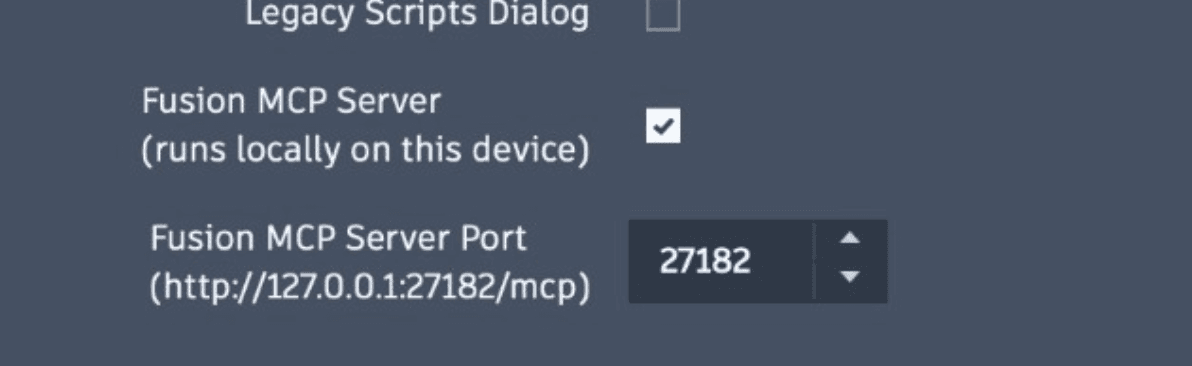
Source: Autodesk Fusion MCP connection guide
3. Add the server to Claude
If you are using Claude Code’s MCP configuration, add the Fusion endpoint using the HTTP transport:
The exact command can vary depending on your Claude environment and the transport supported by the current Fusion release. If you are using Claude Desktop, follow Autodesk’s connector instructions instead of copying a Claude Code command into the Desktop configuration.
Autodesk’s Fusion documentation currently provides detailed client instructions for Claude Desktop, Cursor, and VS Code. Claude Code can use MCP servers through its own MCP commands, but the Fusion endpoint and transport must be compatible with the version you are running.

Source: Autodesk Fusion MCP connection guide
4. Verify the connection
In Claude Code, list the configured servers:
You can also use the /mcp command inside Claude Code to inspect the connection and available tools.
Start with a read-only request:
If Claude returns information from the open Fusion document, test the model context with:
Only enable write operations after confirming that Claude is connected to the correct Fusion session and that the returned information matches the document visible in Fusion. You can find the official setup details in the Autodesk Fusion MCP connection guide.

Source: Autodesk Fusion MCP connection guide
How Do You Use Fusion Data MCP With Claude?
The Fusion Data MCP Server is designed for cloud-based Fusion information rather than direct control of the active Fusion viewport. It runs on Autodesk’s cloud infrastructure, so Fusion does not need to remain open when Claude is searching project data.
Through the Fusion Data MCP Server, Claude may be able to work with:
Autodesk hubs
Fusion projects
Project folders
Design items
Manufacturing Data Model resources
File and project relationships
This makes the server useful at the beginning of a workflow. For example, Claude can help locate the correct project or identify the latest design version before you open that design in the Fusion desktop application.

Source: Autodesk Fusion Data MCP connection guide
Example prompts include:
The cloud server requires an Autodesk account with access to the relevant Fusion data. The client must also support the server’s HTTP transport and authentication flow. When connected for the first time, Claude may ask you to complete an Autodesk sign-in process.
This workflow is different from using the local Fusion MCP Server:
The cloud server can help Claude find and organize project information, but it is not intended to replace the local server when you need to inspect the active Fusion document, create geometry, edit a feature, or review the current viewport.
A useful combined workflow is to use Fusion Data MCP to locate the correct project and design, open that design in Fusion, and then use the local Fusion MCP Server or Computer Use for the live modeling task. The Autodesk Fusion Data MCP connection guide documents the current endpoint and authentication requirements.
How Do You Use Computer Use With Fusion?
Computer Use lets Claude interact with Fusion through the visible desktop interface. Instead of calling a named Fusion tool, Claude receives a screenshot, identifies the relevant controls, requests an action, and receives an updated result.
The basic interaction loop looks like this:
According to Anthropic’s Computer Use documentation, Claude can request actions such as:
Taking a screenshot
Clicking or double-clicking
Typing text
Pressing keyboard shortcuts
Scrolling
Dragging objects
Zooming into a screen region
Waiting for an application to finish loading

Source: Autodesk Fusion Help – Create a 3D section view
In Fusion, this makes Computer Use useful for tasks that depend on the current interface. You could ask Claude to open the Data Panel, switch to the Manufacture workspace, locate a component in the Browser, open the Parameters dialog, or review a section analysis.
For example:
You can also ask Claude to review a visible result:
Computer Use is especially helpful when a Fusion feature is not available through the MCP toolset. It can navigate dialogs and controls that Claude would not be able to access through structured MCP calls alone. However, it is more sensitive to the state of the desktop. Window focus, screen resolution, zoom level, active workspace, and unexpected dialogs can all affect the result.
For that reason, keep Computer Use tasks short and require verification after important actions. A useful instruction is:
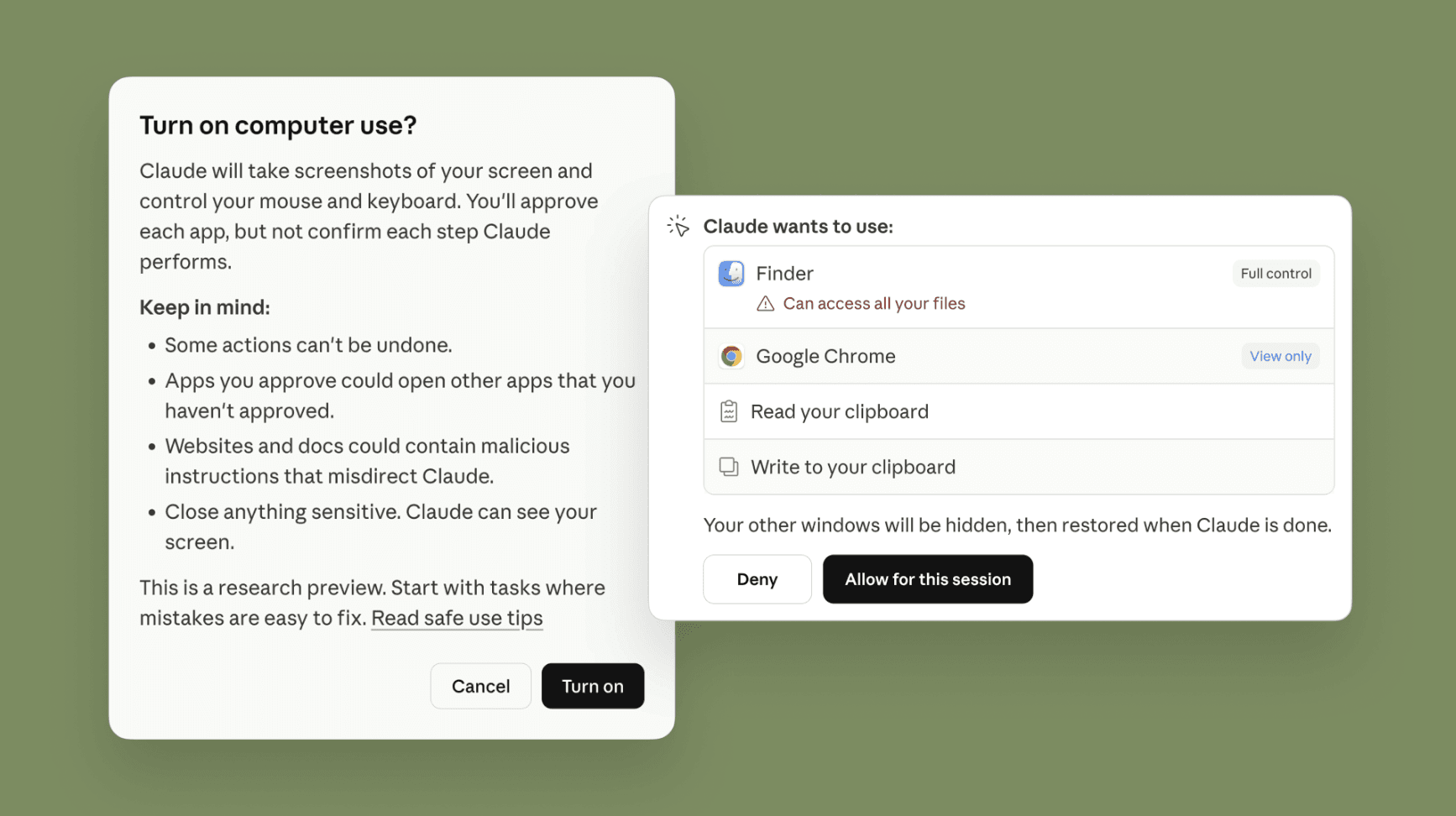
Source: Claude – Put Claude to work on your computer
Computer Use does not mean that Claude has unrestricted access to Fusion. Your application or runtime still has to execute the requested actions. Anthropic recommends using a sandboxed environment, limiting access to sensitive data, and requiring human confirmation for consequential actions.
For a live modeling workflow, use MCP for structured operations and Computer Use for interface navigation and visual verification. This division makes the workflow easier to review and reduces the chance of an unnoticed UI mistake.
What Fusion Workflows Can You Automate With Claude?
The most useful Fusion workflows combine structured MCP operations with visual Computer Use. MCP handles tasks that can be expressed through defined tools or data queries, while Computer Use helps Claude navigate the interface and confirm what is visible in the Fusion workspace.
MCP-oriented workflows
With the local Fusion MCP Server, Claude may be able to inspect the active document, review components, read exposed properties, and execute supported modeling operations. The exact capabilities depend on the tools available in the connected session.
Example prompts include:
For project-level work, Fusion Data MCP can help Claude locate projects, folders, items, and manufacturing data before the design is opened in Fusion.

Source: Autodesk Fusion Blog – Master the Timeline, Browser, & Preferences
Computer Use workflows
Computer Use is useful when the task depends on the visible Fusion interface. Common examples include:
Opening a design from the Data Panel
Switching between Design and Manufacture workspaces
Opening the Parameters or Inspect panel
Selecting or isolating a component in the Browser
Reviewing a simulation or toolpath
Navigating a dialog
Capturing a screenshot for visual confirmation
Checking whether a modeling operation produced the expected result
These actions are flexible, but they require more verification because Claude is interpreting the screen rather than calling a dedicated Fusion tool.
A combined MCP and Computer Use workflow
A practical end-to-end workflow can look like this:
Use Fusion Data MCP to locate the correct project and design.
Open the design in the Fusion desktop application.
Use local Fusion MCP to inspect the model structure.
Ask Claude to explain the proposed change.
Approve the structured operation.
Use Computer Use to open the relevant Fusion panel.
Review the updated model in the viewport.
Save a new version only after checking the result.
This separation keeps each method focused on the type of task it handles best. MCP provides structured access and repeatability. Computer Use provides visual context and interface control.
Autodesk’s Fusion release notes may introduce new MCP capabilities over time, including expanded property and component operations. Because the available toolset can change between releases, the article should not promise that every Fusion command or modeling feature can be controlled through MCP. Check the tools exposed in the current session before planning an automated workflow.
How Do You Use MCP and Computer Use Safely With Fusion?
AI-assisted modeling can affect real designs, project data, and manufacturing workflows. Treat Claude as a supervised assistant rather than an autonomous CAD operator.
Start with a copy or versioned design. Before asking Claude to create, delete, or modify anything, duplicate the file or create a checkpoint that lets you compare the result with the original. Avoid testing a new MCP server or Computer Use workflow on the only copy of a production model.
Begin with read-only requests:
This gives you an opportunity to confirm that Claude is connected to the correct document and has identified the right objects.
Before allowing a write operation, ask Claude to explain:
Which Fusion document it is using
Which component or feature it will change
Which MCP tool or interface action it plans to use
What the expected result should be
Whether the operation can be undone
Require approval before actions such as:
Creating or deleting geometry
Changing dimensions or parameters
Applying a feature
Saving or exporting a design
Overwriting an existing version
Generating manufacturing output
Uploading or sharing project data
For Computer Use, use short action sequences and require a screenshot after each important step. A prompt such as this is safer than a broad instruction:
Common mistakes include confusing the local Fusion MCP Server with Fusion Data MCP, connecting Claude to the wrong Fusion session, assuming every Fusion command is available, and allowing Computer Use to continue after an unexpected dialog appears.
You should also treat content shown inside screenshots, files, and web pages as untrusted. Anthropic recommends using a dedicated virtual machine or container, limiting access to sensitive data, restricting network access where possible, and requiring human confirmation for consequential actions. These precautions help reduce the impact of accidental actions and prompt injection.
Finally, verify the actual Fusion result. Claude’s final response does not prove that the intended change was applied correctly. Check the Browser, Timeline, parameters, viewport, and saved version before relying on the result.
Run Fusion and Claude Together on Vagon Cloud Computer
Running Fusion with Claude can require more than a capable local laptop. Fusion needs a desktop application for the local MCP connection, while Computer Use needs a persistent graphical environment that Claude can observe and control.
Vagon Cloud Computer gives you a remote Windows workstation that you can access through a browser or app. You can install Fusion, configure Claude, keep the MCP connection active, and work with your project files in the same environment.
This setup is particularly useful when:
Your local device does not run the Windows version of Fusion comfortably
You need a stronger GPU for large assemblies or demanding visual work
You want Fusion and Claude to remain available in one persistent desktop
You work across a Mac, tablet, Chromebook, or other lower-powered device
You want to separate AI-assisted testing from your main computer
A typical workflow looks like this:
Create a Vagon Cloud Computer with enough CPU, RAM, and GPU performance for your Fusion projects.
Install the Windows version of Fusion.
Install and configure Claude.
Enable the local Fusion MCP Server.
Add the MCP endpoint to your Claude environment.
Run Computer Use inside the same graphical desktop.
Keep project files versioned and review every consequential action.
Vagon does not replace Fusion licensing, Autodesk authentication, Claude permissions, or MCP configuration. It provides the persistent Windows environment where these components can run together.
For a safer setup, use a separate Vagon computer for testing new connectors and Computer Use workflows. Keep production credentials and unrelated files outside the environment, and shut down the machine when the session is complete. This gives you a practical way to run Fusion and Claude together without depending entirely on the hardware or operating system of your local device.
FAQs
Can Claude control Autodesk Fusion directly?
Claude can work with Fusion through an MCP connection or Computer Use. MCP provides access to supported Fusion tools, while Computer Use allows Claude to interact with the visible Fusion interface through screenshots and desktop actions.
What is the difference between Fusion MCP and Fusion Data MCP?
The local Fusion MCP Server works with a running Fusion desktop session. Fusion Data MCP is cloud-based and focuses on hubs, projects, folders, items, and related project data.
Does Fusion need to be open for MCP to work?
Fusion must be open for the local Fusion MCP Server. The Fusion Data MCP Server can work without the Fusion desktop application because it runs through Autodesk cloud services.
Can Claude create or modify Fusion geometry?
Claude may be able to create or modify geometry when the required operation is exposed through the connected MCP tools. The available capabilities depend on the current Fusion MCP version. Always request approval before applying design changes.
Can Claude use Fusion through Computer Use?
Yes. Computer Use can help Claude open panels, switch workspaces, select components, navigate dialogs, and review visible modeling results. It depends on the state of the desktop and should be used with screenshot-based verification.
Is Claude Code officially supported by Autodesk Fusion MCP?
Autodesk’s current Fusion documentation explicitly lists clients such as Claude Desktop, Cursor, and VS Code. Claude Code supports MCP servers, but a Claude Code connection should be tested against the current Fusion endpoint and transport rather than presented as a fully documented Autodesk integration.
Is Computer Use safe for production Fusion projects?
Computer Use should not be given unrestricted access to production designs. Use a versioned copy, limit permissions, isolate the environment, and require confirmation before saving, exporting, deleting, or applying changes.
Can MCP and Computer Use be used together?
Yes. A practical workflow is to use MCP for structured inspection or modeling operations and Computer Use to navigate Fusion and verify the visible result.
Can I run Fusion and Claude on Vagon Cloud Computer?
Yes, provided the Vagon environment meets the requirements for Fusion and the required Claude workflow. Vagon provides a persistent Windows desktop, but you still need valid Autodesk and Claude access, Fusion installation, MCP configuration, and appropriate user approvals.
Claude can work with Autodesk Fusion in two different ways. In the simplest workflow, it can explain modeling steps or generate Fusion API code that you apply manually. A connected workflow goes further by linking Claude to a live Fusion session through an Autodesk Fusion MCP Server or by allowing it to interact with the visible desktop through Computer Use.
MCP gives Claude structured access to supported Fusion tools and data. Depending on the available server capabilities, Claude may inspect the active document, review components, execute modeling commands, or query cloud-based hubs, projects, folders, and design items. Computer Use handles the visual side of the workflow. It can interpret screenshots, open Fusion panels, click controls, type values, navigate dialogs, and verify the result on screen.
The two methods work best together. MCP provides more precise and repeatable operations, while Computer Use helps Claude navigate the interface and confirm what actually happened. This is not a native one-click Fusion feature. It requires a compatible Claude environment, an MCP connection or Computer Use runtime, a running Fusion desktop session for local modeling, and user approval before consequential changes.
What Can Claude Do With Fusion Through MCP and Computer Use?
Claude can work with Fusion at two different levels: structured model data and the visible desktop interface.
Through the local Fusion MCP Server, Claude can access the capabilities exposed by the active Fusion session. This may include inspecting the current document, reviewing components, reading design properties, executing supported modeling commands, and working with structured Fusion objects. The exact tool list is dynamic, so the available capabilities depend on the Fusion release and the connected MCP server.
Autodesk also provides the Fusion Data MCP Server. This cloud-based server is designed for working with hubs, projects, folders, items, and other Fusion Manufacturing Data Model resources. It can help Claude locate the correct project or design before you open it in the Fusion desktop application. It does not replace the local server when you need to work with the active viewport or modify live geometry.
Computer Use covers the interface layer. Claude can receive screenshots and request actions such as clicking, typing, dragging, scrolling, zooming, and taking another screenshot. In Fusion, this can help it open the Data Panel, switch between Design and Manufacture workspaces, access the Inspect or Parameters panels, select components, navigate dialogs, and review visible model states.
A practical workflow combines both methods. Claude can use MCP to inspect a component or prepare a structured operation, wait for your approval, and then use Computer Use to open the relevant Fusion panel and verify the visible result. This gives you structured control where precision matters and visual control where the task depends on Fusion’s interface.
MCP vs. Computer Use: Which Fusion Connection Should You Use?
MCP and Computer Use solve different problems. The right choice depends on whether Claude needs structured access to Fusion data or visual control of the application interface.
Task | Better option |
|---|---|
Inspect the active Fusion document | Local Fusion MCP |
Review components and properties | Local Fusion MCP |
Query hubs, projects, and folders | Fusion Data MCP |
Execute a supported modeling operation | Local Fusion MCP |
Open a panel or dialog | Computer Use |
Switch workspaces | Computer Use |
Review the visible viewport | Computer Use |
Work with an unsupported UI feature | Computer Use |
Apply a structured change and verify it visually | MCP plus Computer Use |
The local Fusion MCP Server is usually the better option for precise and repeatable operations. Instead of relying on screen coordinates, Claude calls named tools exposed by the server. This makes the workflow easier to describe, repeat, and audit. It is also useful when Claude needs information about the active document that may not be obvious from the viewport.
Computer Use is more flexible when the task depends on what is currently visible. Claude can inspect the screen, locate a control, open a menu, or respond to a dialog that is not available as an MCP tool. However, the result can depend on window focus, screen resolution, zoom level, workspace state, and changes in Fusion’s interface.
The most reliable workflow often combines the two. For example, Claude can use Fusion MCP to inspect a component and prepare a proposed change. After you approve it, Computer Use can open the relevant Fusion panel and confirm that the expected result appears in the viewport.
Use MCP when precision and repeatability matter. Use Computer Use when visual context and interface navigation matter. If a task involves both, give each method a clear role instead of asking Computer Use to perform every operation.
How Do You Connect Claude to the Autodesk Fusion MCP Server?
The local Fusion MCP workflow starts inside the Fusion desktop application. Unlike the cloud-based Fusion Data MCP Server, the local server connects Claude to a running Fusion session and works with the document currently open on screen.
1. Open Fusion
Launch the installed Fusion desktop application and open a design that you can safely test. The local server is hosted by Fusion, so the application must remain open while Claude is using the connection.
Autodesk specifically describes this as a desktop workflow, not a browser-only Fusion workflow. For early testing, use a copy or a non-production design.
2. Enable the Fusion MCP Server
Open Fusion Preferences and go to:
Enable the Fusion MCP Server option. Fusion displays the local MCP endpoint and port. Autodesk’s current documentation uses:
The port may change in a future release or if you edit it manually, so use the value shown in your Fusion settings rather than assuming it is always the same.
Source: Autodesk Fusion MCP connection guide
3. Add the server to Claude
If you are using Claude Code’s MCP configuration, add the Fusion endpoint using the HTTP transport:
The exact command can vary depending on your Claude environment and the transport supported by the current Fusion release. If you are using Claude Desktop, follow Autodesk’s connector instructions instead of copying a Claude Code command into the Desktop configuration.
Autodesk’s Fusion documentation currently provides detailed client instructions for Claude Desktop, Cursor, and VS Code. Claude Code can use MCP servers through its own MCP commands, but the Fusion endpoint and transport must be compatible with the version you are running.
Source: Autodesk Fusion MCP connection guide
4. Verify the connection
In Claude Code, list the configured servers:
You can also use the /mcp command inside Claude Code to inspect the connection and available tools.
Start with a read-only request:
If Claude returns information from the open Fusion document, test the model context with:
Only enable write operations after confirming that Claude is connected to the correct Fusion session and that the returned information matches the document visible in Fusion. You can find the official setup details in the Autodesk Fusion MCP connection guide.
Source: Autodesk Fusion MCP connection guide
How Do You Use Fusion Data MCP With Claude?
The Fusion Data MCP Server is designed for cloud-based Fusion information rather than direct control of the active Fusion viewport. It runs on Autodesk’s cloud infrastructure, so Fusion does not need to remain open when Claude is searching project data.
Through the Fusion Data MCP Server, Claude may be able to work with:
Autodesk hubs
Fusion projects
Project folders
Design items
Manufacturing Data Model resources
File and project relationships
This makes the server useful at the beginning of a workflow. For example, Claude can help locate the correct project or identify the latest design version before you open that design in the Fusion desktop application.
Source: Autodesk Fusion Data MCP connection guide
Example prompts include:
The cloud server requires an Autodesk account with access to the relevant Fusion data. The client must also support the server’s HTTP transport and authentication flow. When connected for the first time, Claude may ask you to complete an Autodesk sign-in process.
This workflow is different from using the local Fusion MCP Server:
The cloud server can help Claude find and organize project information, but it is not intended to replace the local server when you need to inspect the active Fusion document, create geometry, edit a feature, or review the current viewport.
A useful combined workflow is to use Fusion Data MCP to locate the correct project and design, open that design in Fusion, and then use the local Fusion MCP Server or Computer Use for the live modeling task. The Autodesk Fusion Data MCP connection guide documents the current endpoint and authentication requirements.
How Do You Use Computer Use With Fusion?
Computer Use lets Claude interact with Fusion through the visible desktop interface. Instead of calling a named Fusion tool, Claude receives a screenshot, identifies the relevant controls, requests an action, and receives an updated result.
The basic interaction loop looks like this:
According to Anthropic’s Computer Use documentation, Claude can request actions such as:
Taking a screenshot
Clicking or double-clicking
Typing text
Pressing keyboard shortcuts
Scrolling
Dragging objects
Zooming into a screen region
Waiting for an application to finish loading
Source: Autodesk Fusion Help – Create a 3D section view
In Fusion, this makes Computer Use useful for tasks that depend on the current interface. You could ask Claude to open the Data Panel, switch to the Manufacture workspace, locate a component in the Browser, open the Parameters dialog, or review a section analysis.
For example:
You can also ask Claude to review a visible result:
Computer Use is especially helpful when a Fusion feature is not available through the MCP toolset. It can navigate dialogs and controls that Claude would not be able to access through structured MCP calls alone. However, it is more sensitive to the state of the desktop. Window focus, screen resolution, zoom level, active workspace, and unexpected dialogs can all affect the result.
For that reason, keep Computer Use tasks short and require verification after important actions. A useful instruction is:
Source: Claude – Put Claude to work on your computer
Computer Use does not mean that Claude has unrestricted access to Fusion. Your application or runtime still has to execute the requested actions. Anthropic recommends using a sandboxed environment, limiting access to sensitive data, and requiring human confirmation for consequential actions.
For a live modeling workflow, use MCP for structured operations and Computer Use for interface navigation and visual verification. This division makes the workflow easier to review and reduces the chance of an unnoticed UI mistake.
What Fusion Workflows Can You Automate With Claude?
The most useful Fusion workflows combine structured MCP operations with visual Computer Use. MCP handles tasks that can be expressed through defined tools or data queries, while Computer Use helps Claude navigate the interface and confirm what is visible in the Fusion workspace.
MCP-oriented workflows
With the local Fusion MCP Server, Claude may be able to inspect the active document, review components, read exposed properties, and execute supported modeling operations. The exact capabilities depend on the tools available in the connected session.
Example prompts include:
For project-level work, Fusion Data MCP can help Claude locate projects, folders, items, and manufacturing data before the design is opened in Fusion.
Source: Autodesk Fusion Blog – Master the Timeline, Browser, & Preferences
Computer Use workflows
Computer Use is useful when the task depends on the visible Fusion interface. Common examples include:
Opening a design from the Data Panel
Switching between Design and Manufacture workspaces
Opening the Parameters or Inspect panel
Selecting or isolating a component in the Browser
Reviewing a simulation or toolpath
Navigating a dialog
Capturing a screenshot for visual confirmation
Checking whether a modeling operation produced the expected result
These actions are flexible, but they require more verification because Claude is interpreting the screen rather than calling a dedicated Fusion tool.
A combined MCP and Computer Use workflow
A practical end-to-end workflow can look like this:
Use Fusion Data MCP to locate the correct project and design.
Open the design in the Fusion desktop application.
Use local Fusion MCP to inspect the model structure.
Ask Claude to explain the proposed change.
Approve the structured operation.
Use Computer Use to open the relevant Fusion panel.
Review the updated model in the viewport.
Save a new version only after checking the result.
This separation keeps each method focused on the type of task it handles best. MCP provides structured access and repeatability. Computer Use provides visual context and interface control.
Autodesk’s Fusion release notes may introduce new MCP capabilities over time, including expanded property and component operations. Because the available toolset can change between releases, the article should not promise that every Fusion command or modeling feature can be controlled through MCP. Check the tools exposed in the current session before planning an automated workflow.
How Do You Use MCP and Computer Use Safely With Fusion?
AI-assisted modeling can affect real designs, project data, and manufacturing workflows. Treat Claude as a supervised assistant rather than an autonomous CAD operator.
Start with a copy or versioned design. Before asking Claude to create, delete, or modify anything, duplicate the file or create a checkpoint that lets you compare the result with the original. Avoid testing a new MCP server or Computer Use workflow on the only copy of a production model.
Begin with read-only requests:
This gives you an opportunity to confirm that Claude is connected to the correct document and has identified the right objects.
Before allowing a write operation, ask Claude to explain:
Which Fusion document it is using
Which component or feature it will change
Which MCP tool or interface action it plans to use
What the expected result should be
Whether the operation can be undone
Require approval before actions such as:
Creating or deleting geometry
Changing dimensions or parameters
Applying a feature
Saving or exporting a design
Overwriting an existing version
Generating manufacturing output
Uploading or sharing project data
For Computer Use, use short action sequences and require a screenshot after each important step. A prompt such as this is safer than a broad instruction:
Common mistakes include confusing the local Fusion MCP Server with Fusion Data MCP, connecting Claude to the wrong Fusion session, assuming every Fusion command is available, and allowing Computer Use to continue after an unexpected dialog appears.
You should also treat content shown inside screenshots, files, and web pages as untrusted. Anthropic recommends using a dedicated virtual machine or container, limiting access to sensitive data, restricting network access where possible, and requiring human confirmation for consequential actions. These precautions help reduce the impact of accidental actions and prompt injection.
Finally, verify the actual Fusion result. Claude’s final response does not prove that the intended change was applied correctly. Check the Browser, Timeline, parameters, viewport, and saved version before relying on the result.
Run Fusion and Claude Together on Vagon Cloud Computer
Running Fusion with Claude can require more than a capable local laptop. Fusion needs a desktop application for the local MCP connection, while Computer Use needs a persistent graphical environment that Claude can observe and control.
Vagon Cloud Computer gives you a remote Windows workstation that you can access through a browser or app. You can install Fusion, configure Claude, keep the MCP connection active, and work with your project files in the same environment.
This setup is particularly useful when:
Your local device does not run the Windows version of Fusion comfortably
You need a stronger GPU for large assemblies or demanding visual work
You want Fusion and Claude to remain available in one persistent desktop
You work across a Mac, tablet, Chromebook, or other lower-powered device
You want to separate AI-assisted testing from your main computer
A typical workflow looks like this:
Create a Vagon Cloud Computer with enough CPU, RAM, and GPU performance for your Fusion projects.
Install the Windows version of Fusion.
Install and configure Claude.
Enable the local Fusion MCP Server.
Add the MCP endpoint to your Claude environment.
Run Computer Use inside the same graphical desktop.
Keep project files versioned and review every consequential action.
Vagon does not replace Fusion licensing, Autodesk authentication, Claude permissions, or MCP configuration. It provides the persistent Windows environment where these components can run together.
For a safer setup, use a separate Vagon computer for testing new connectors and Computer Use workflows. Keep production credentials and unrelated files outside the environment, and shut down the machine when the session is complete. This gives you a practical way to run Fusion and Claude together without depending entirely on the hardware or operating system of your local device.
FAQs
Can Claude control Autodesk Fusion directly?
Claude can work with Fusion through an MCP connection or Computer Use. MCP provides access to supported Fusion tools, while Computer Use allows Claude to interact with the visible Fusion interface through screenshots and desktop actions.
What is the difference between Fusion MCP and Fusion Data MCP?
The local Fusion MCP Server works with a running Fusion desktop session. Fusion Data MCP is cloud-based and focuses on hubs, projects, folders, items, and related project data.
Does Fusion need to be open for MCP to work?
Fusion must be open for the local Fusion MCP Server. The Fusion Data MCP Server can work without the Fusion desktop application because it runs through Autodesk cloud services.
Can Claude create or modify Fusion geometry?
Claude may be able to create or modify geometry when the required operation is exposed through the connected MCP tools. The available capabilities depend on the current Fusion MCP version. Always request approval before applying design changes.
Can Claude use Fusion through Computer Use?
Yes. Computer Use can help Claude open panels, switch workspaces, select components, navigate dialogs, and review visible modeling results. It depends on the state of the desktop and should be used with screenshot-based verification.
Is Claude Code officially supported by Autodesk Fusion MCP?
Autodesk’s current Fusion documentation explicitly lists clients such as Claude Desktop, Cursor, and VS Code. Claude Code supports MCP servers, but a Claude Code connection should be tested against the current Fusion endpoint and transport rather than presented as a fully documented Autodesk integration.
Is Computer Use safe for production Fusion projects?
Computer Use should not be given unrestricted access to production designs. Use a versioned copy, limit permissions, isolate the environment, and require confirmation before saving, exporting, deleting, or applying changes.
Can MCP and Computer Use be used together?
Yes. A practical workflow is to use MCP for structured inspection or modeling operations and Computer Use to navigate Fusion and verify the visible result.
Can I run Fusion and Claude on Vagon Cloud Computer?
Yes, provided the Vagon environment meets the requirements for Fusion and the required Claude workflow. Vagon provides a persistent Windows desktop, but you still need valid Autodesk and Claude access, Fusion installation, MCP configuration, and appropriate user approvals.
Get Beyond Your Computer Performance
Run applications on your cloud computer with the latest generation hardware. No more crashes or lags.

Trial includes 1 hour usage + 7 days of storage.
Summarize with AI
Ready to focus on your creativity?
Vagon gives you the ability to create & render projects, collaborate, and stream applications with the power of the best hardware.

Vagon Blog
Run heavy applications on any device with
your personal computer on the cloud.
San Francisco, California
Solutions
Vagon Teams
Vagon Streams
Use Cases
Resources
Vagon Blog
How to Use Revit With Claude: MCP & Computer Use
How to Use CATIA With Claude: MCP & Computer Use
How to Use CATIA With Codex: MCP & Computer Use Guide
How to Use Autodesk Fusion With Claude: MCP & Computer Use
How to Use Fusion With Codex: MCP and Computer Use Guide
How to Use AutoCAD With Codex: Live MCP Setup Guide
How to Use AutoCAD With Claude Code: MCP Guide
How to Use Codex With Maya: Python, MEL & Cloud Workflow
How to Use Claude Code With Maya: MCP Setup Guide (2026)
Vagon Blog
Run heavy applications on any device with
your personal computer on the cloud.
San Francisco, California
Solutions
Vagon Teams
Vagon Streams
Use Cases
Resources
Vagon Blog
How to Use Revit With Claude: MCP & Computer Use
How to Use CATIA With Claude: MCP & Computer Use
How to Use CATIA With Codex: MCP & Computer Use Guide
How to Use Autodesk Fusion With Claude: MCP & Computer Use
How to Use Fusion With Codex: MCP and Computer Use Guide
How to Use AutoCAD With Codex: Live MCP Setup Guide
How to Use AutoCAD With Claude Code: MCP Guide
How to Use Codex With Maya: Python, MEL & Cloud Workflow
How to Use Claude Code With Maya: MCP Setup Guide (2026)
Vagon Blog
Run heavy applications on any device with
your personal computer on the cloud.
San Francisco, California
Solutions
Vagon Teams
Vagon Streams
Use Cases
Resources
Vagon Blog